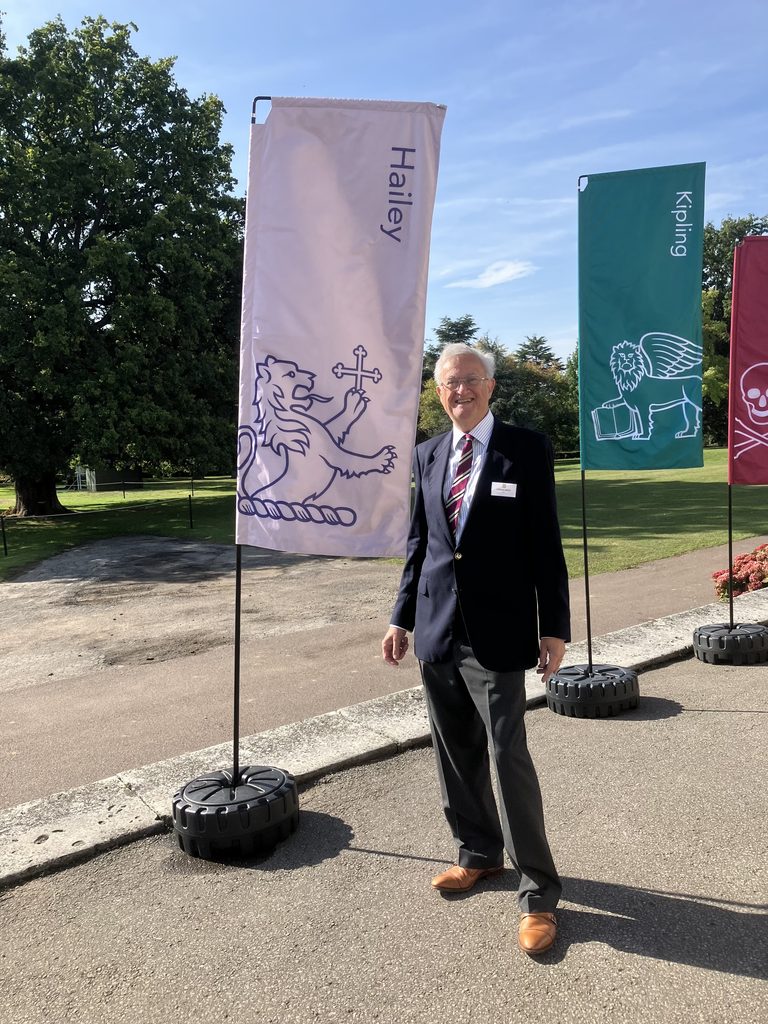
We were delighted to catch up OH William Miller (Hailey). William shared this wonderful write up on a lecture he delivered at Wantage museum earlier this month. Thank you to William for sharing his findings with the rest of the Association community, we look forward to hearing about future talks that he delivers.
I recently moved to Wantage near Oxford, and in addition to joining the near Cathedral standard choir in the local church, and becoming a conservation volunteer at the St John Betjeman Millennium Park, I exercised by exploring the ancient Ridgeway track which runs along the West Berkshire Downs and links up with the Icknield Way in the Chilterns.
I instantly became enchanted and fascinated by the many Iron Age Hillforts, and other heritage sites, along the Ridgeway, and decided to read deeply about their history. A lot is spoken about the famous Saxon King Alfred here because he was born in Wantage. But to my astonishment, I discovered, in reading about the Iron Age, that there had been a previous royal Dynasty who had ruled much of what became Wessex nearly 1000 years before King Alfred. I couldn’t find anyone in the town who had heard of King Commios, whose family ruled here between 50 BC and the Roman invasion of 43 AD.
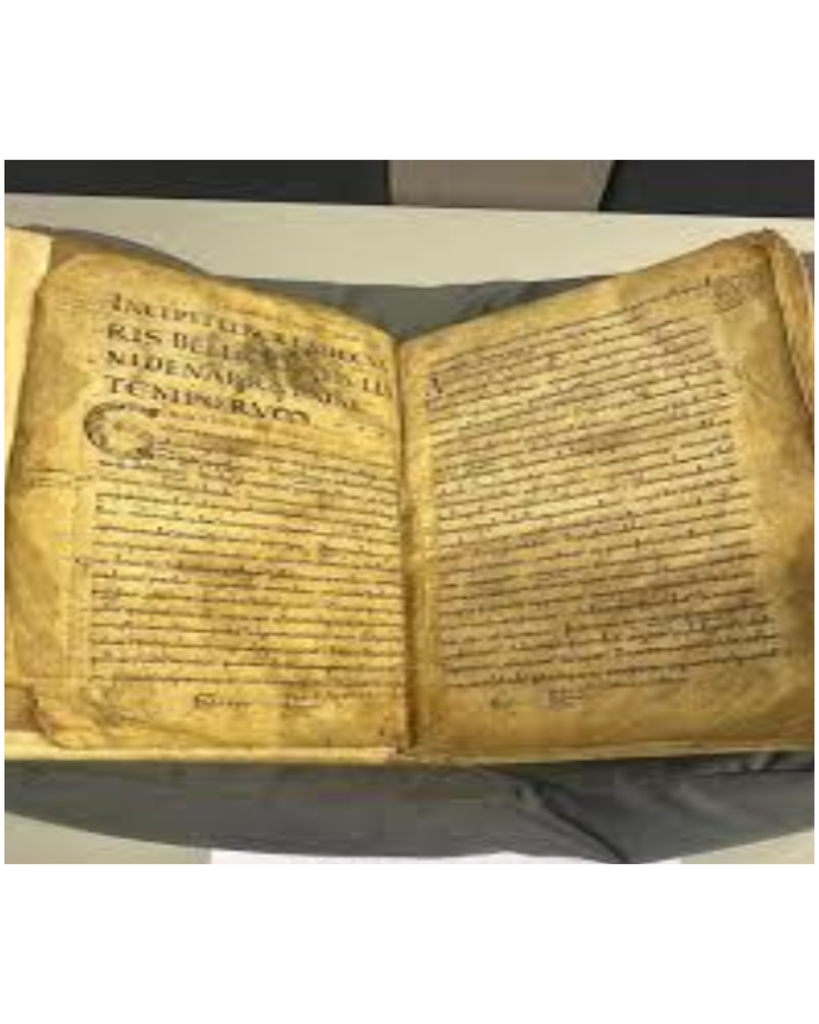
So, sticking my neck out a little, bearing in mind that I am an environmental scientist not a historian, and had only lived in Wantage for a couple of months, I decided to work up a lecture on the subject, and I started by buying six doorstop-sized, academic history and archaeology books by prominent experts such as Barry Cunliffe and Michael Fulford. I visited about six museums, including the Novium Museum in Chichester and the Ashmolean in Oxford. I was delighted to find that Julius Caesar had met King Commios and had written extensively about him in his account of his invasion of Gaul between 57-52 BC. Caesar wrote his “Commentarii de Bello Gallico” on papyrus and his original text has long decayed. But luckily it was copied and there is a ninth century copy in a museum in Amsterdam, and there are other copies of similar date. I immediately bought an English translation. Several other classical writers wrote about Commios and I obtained their texts.
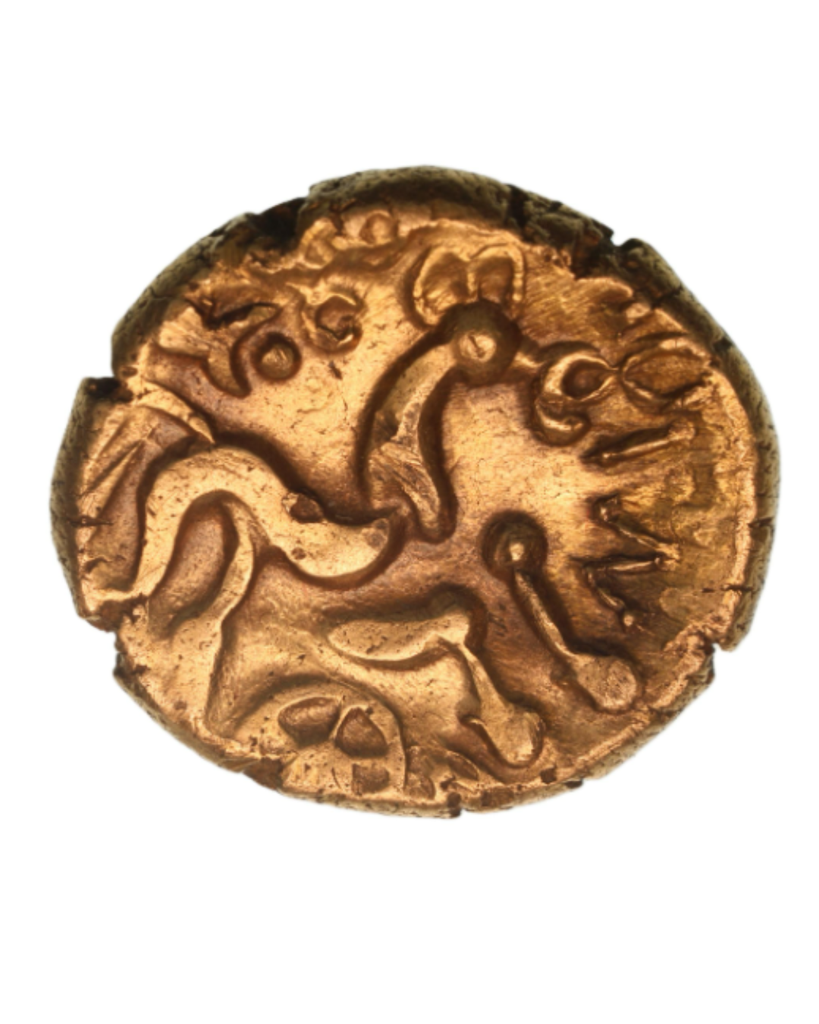
I then discovered that King Commios was the first British king to mint coins depicting his name. So, in addition to the written classical sources, I discovered that a great deal could be learnt about the history of the Commios Royal Dynasty from the information shown on the coins minted by all five members of his family who ruled during this period. I was so enchanted by the quality of their designs that I decided to approach reputable coin dealers, and I have purchased gold and silver coins minted by each of these kings as an investment. Perhaps most fascinating is that they stamped the latin word REX on their coins, years before the Roman conquest. I learned extraordinary facts such as that the design of these coins came originally from a famous gold coin minted by Philip II of Macedon in about 350 BC, which depicted a chariot drawn by horses, which he owned, which won the old Olympic Games on two occasions. This coin travelled along the Danube and became known to all the countries of Western Europe. The Gauls started minting coins depicting stylised horses and chariots in about 150 BC. Commius’ first coins were based on these Gallic designs.
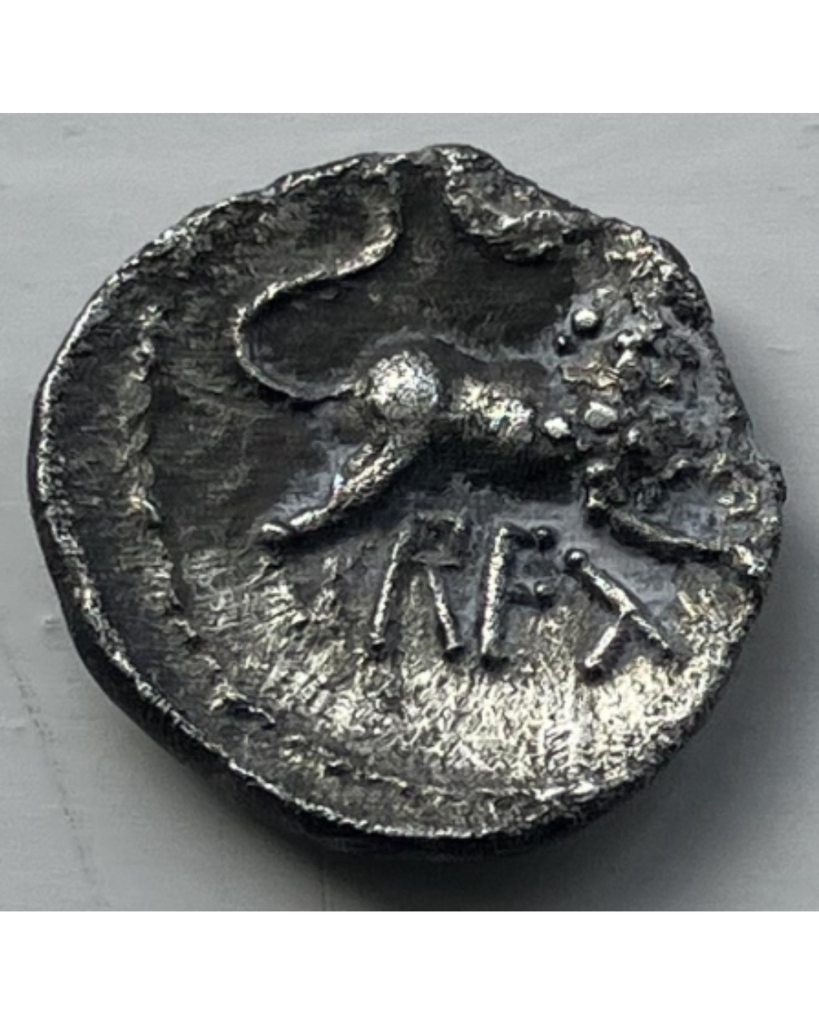
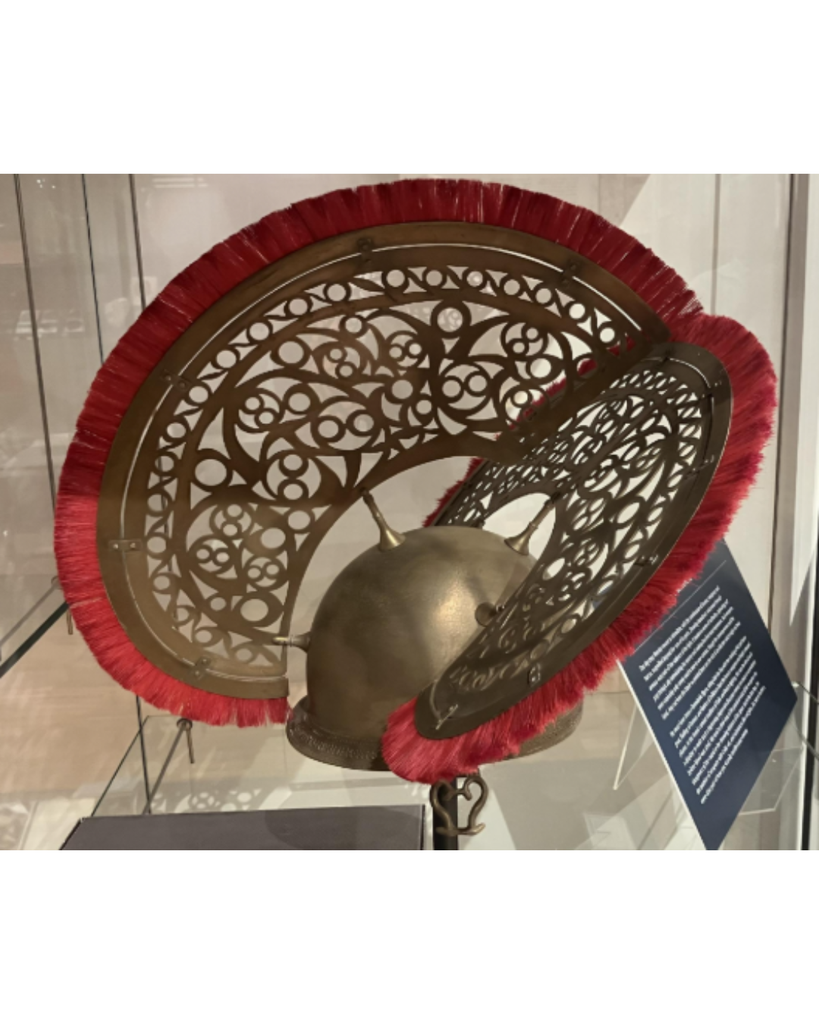
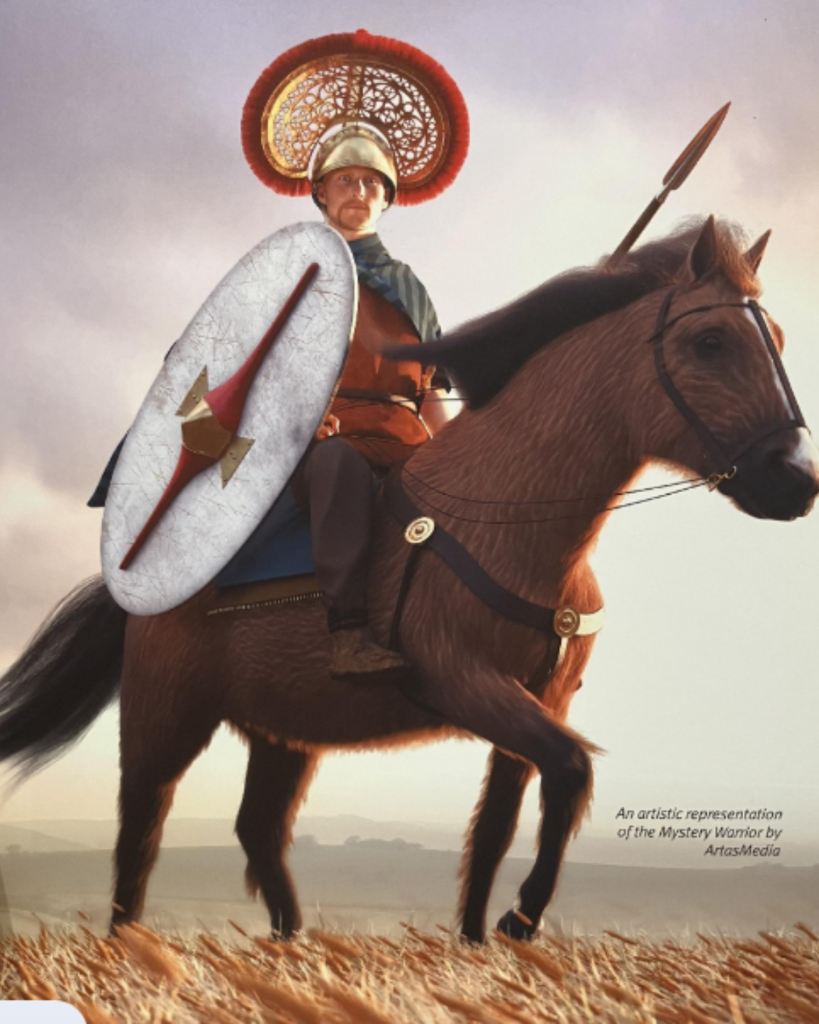
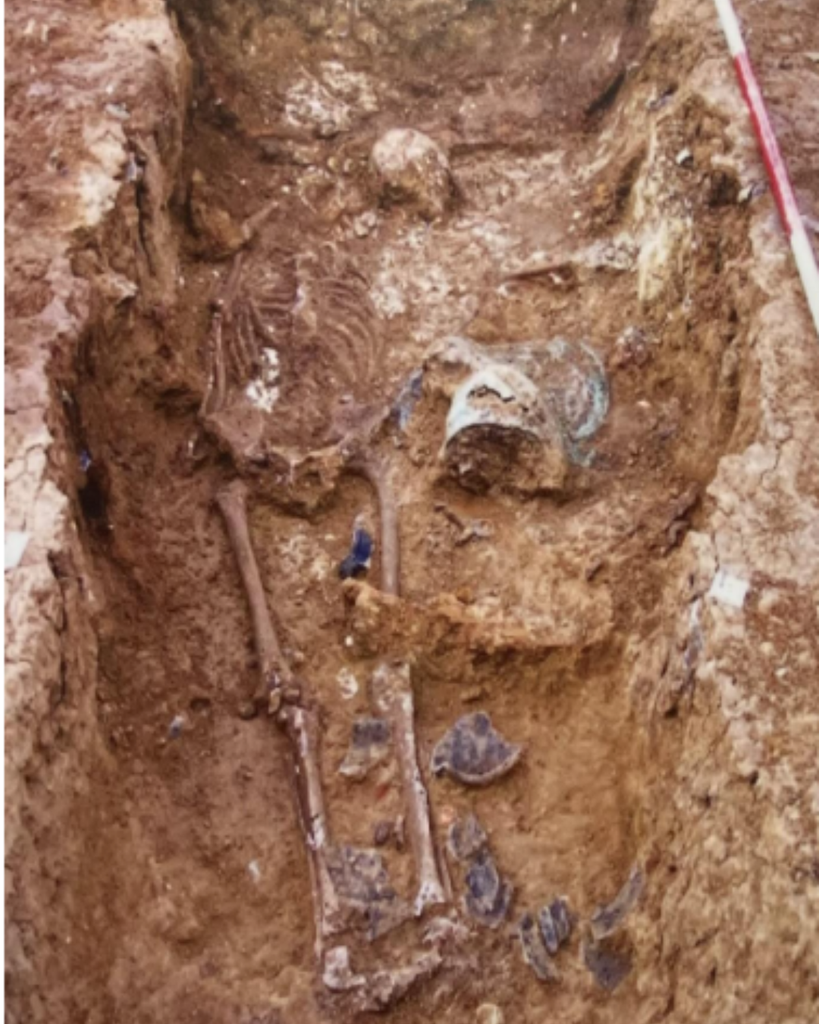
The third source of information for my lecture was archaeology and the many reports of digs that had been written about finds made in Commios’ tribal area which the Romans called the Atrebates. I discovered that their territory extended from the north at the River Thames near Abingdon, to Chichester and Selsey Bill in the south, and in the west to the River Test, and in the east to the River Arun. Perhaps the most dramatic archaeological find was that of a high status warrior near Chichester. His bones showed that he was a powerful horseman and he was buried with a rich collection of grave goods, including a most elaborate bronze helmet and a sword, both of Gallic design. The grave was dated to 50 BC, and some historians actually believe this may be the grave of King Commius (senior) himself. The reconstruction of the extraordinary helmet, and the artist’s impression of how this elite warrior would have looked like in his cavalry uniform, show what an amazing impact this man would’ve had on all who saw him.
All tickets for my lecture were sold out and I have met more than 10 people who were unable to get tickets. The museum was so delighted with my talk that they are recommending to management that I be asked to give it again to a much larger audience.
I have also been invited by Café Scientific to give a version of the talk to a group of scientists, mainly from nearby Harwell, who meet monthly in Wantage. They want me to add a scientific bent to my talk, and it will be easy for me to discuss how Iron Age tribes obtained gold and silver, where from, how they refined it and how they made it into such beautiful coins.
As I was unknown in Wantage and had never spoken publicly here, I felt that I needed a reference to my ability to lecture. Luckily, I have lectured many times in the History Department of Las Palmas University, and in the British Club there, about the history of my family which is well known in Gran Canaria, We lived there since 1812, and have done much to boost the local economy and charity sectors. The kind lady Professor of English wrote me an admirable reference which I was able to show to the management of the Wantage museum. This helped to encourage them to give me a chance to lecture there.